

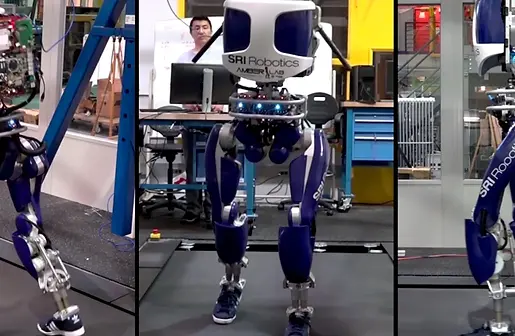
Structural Stability for High-Risk Robotic Systems
Robots fail less from AI limitations — and more from structural instability.
Vibration, deflection, fatigue and joint overload are the real performance killers.
2IS stabilizes robotic structures before production risk becomes expensive reality.

2IS Robot Structural Risk Review (RSRR)
A focused engineering assessment to eliminate structural uncertainty.
What we do:
✔ Load Envelope Definition
✔ Dynamic & Impact Load Modeling
✔ Multi-Scenario FEA Verification
✔ Modal Stability Screening
✔ Fatigue Life Estimation
✔ Joint & Reducer Torque Margin Validation
✔ Lightweight Optimization Strategy
Typical Output:
-
Risk Level Map (Red / Yellow / Green)
-
Stability Margin Summary
-
Top Structural Risk List
-
Optimization Roadmap
Best Fit Applications
2IS delivers strongest value in:
-
Heavy payload manipulators
-
High-speed robotic arms
-
Humanoid / legged robots
-
Mobile robotic chassis
-
Field-deployed or rugged systems
If your system experiences:
High acceleration
Impact events
Long duty cycles
Precision requirements
Structural stability must be verified early.
Our Engineering Philosophy
Many robotics teams design structure to follow control.
2IS designs structure so control does not need to compensate.
Control should follow a stable structure —
not mask instability.
We focus on:
-
Optimal load paths
-
Stiffness-to-weight efficiency
-
Verified safety margins
-
Production-ready validation logic
Information Required to Start
To perform a review, we typically request:
-
CAD (or simplified geometry)
-
Payload & motion profile
-
Acceleration limits
-
Duty cycle
-
Accuracy requirements
-
Known constraints
If CAD is not finalized, we can start with a conceptual risk screening.
Stabilize Before Production
Before design freeze or prototype build,
a structural review can prevent costly redesign cycles.